 CalcElf
Floating plastic block: submerged fraction
A plastic block of density 0.5 g/cm³ floats in water of density 1.0 g/cm³. What fraction of its total volume is submerged?
Step-by-step
- V_sub/V = ρ_object/ρ_fluid = 0.5/1 = 50%When floating, buoyancy equals weight: ρ_fluid·g·V_sub = ρ_object·g·V
- ρ_object = 0.5 , ρ_fluid = 1Comparing the object's density with the liquid's tells you whether it floats
Why it works
A floating body is in balance, so the upthrust equals its weight: ρ_water × V_submerged = ρ_block × V_total. The submerged fraction is therefore the block's density divided by the water's density, independent of how big the block is.
Common mistakes
- Dividing the water density by the block density instead of the other way round.
- Thinking a larger block would submerge a larger fraction of itself.
Related
buoyancy-float buoyancy-wood-block-float-ratio buoyancy-iceberg-submerged-fraction
Stage diagrams
Set up 1 — Floating plastic block: submerged fraction
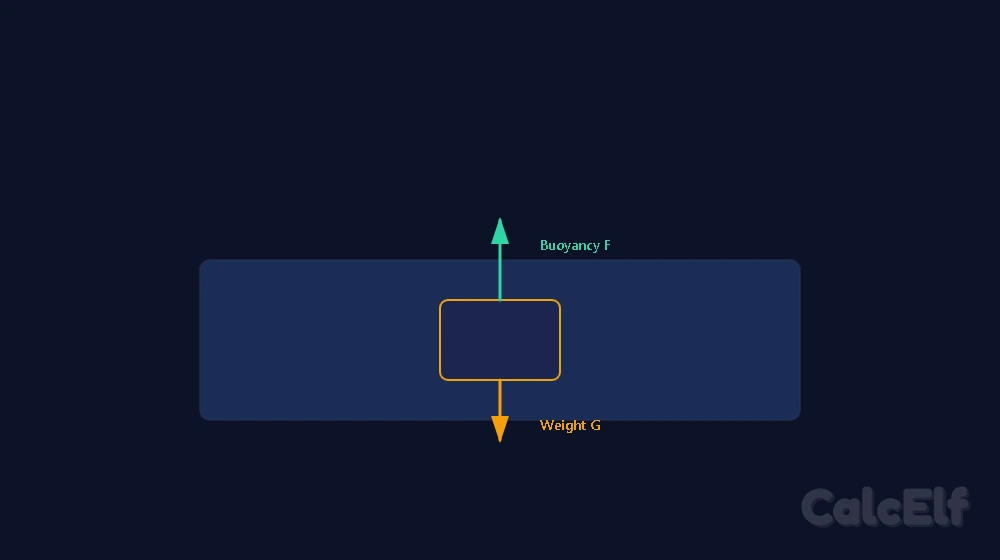
Stage 1 — Set up: Read the problem and mark the given values and the target. Floating plastic block: submerged fraction
A floating body is in balance, so the upthrust equals its weight: ρ_water × V_submerged = ρ_block × V_total.
Work the relation 2 — Floating plastic block: submerged fraction
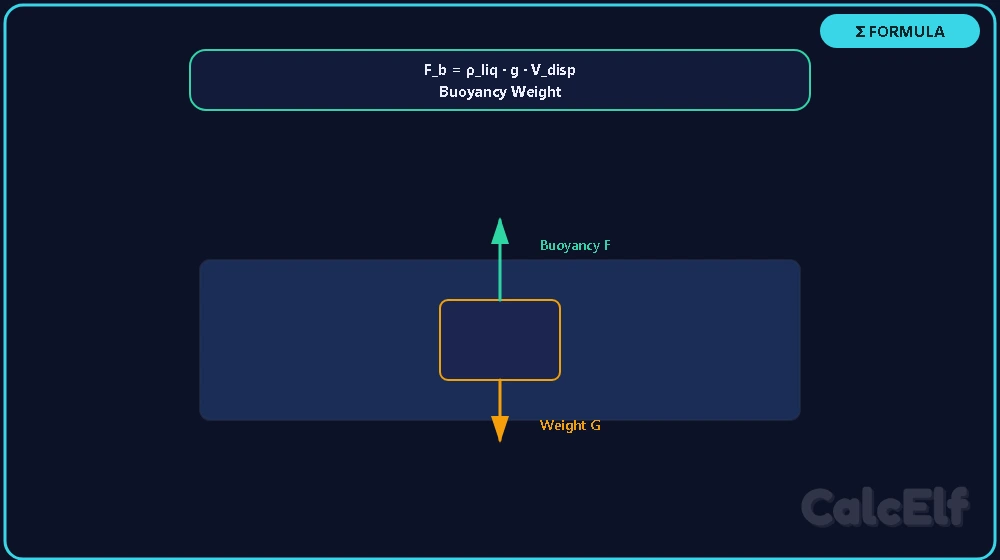
Stage 2 — Work the relation: V_sub/V = ρ_obj/ρ_liq = 0.5/1 = 50%
A floating body is in balance, so the upthrust equals its weight: ρ_water × V_submerged = ρ_block × V_total.
Conclusion 3 — Floating plastic block: submerged fraction
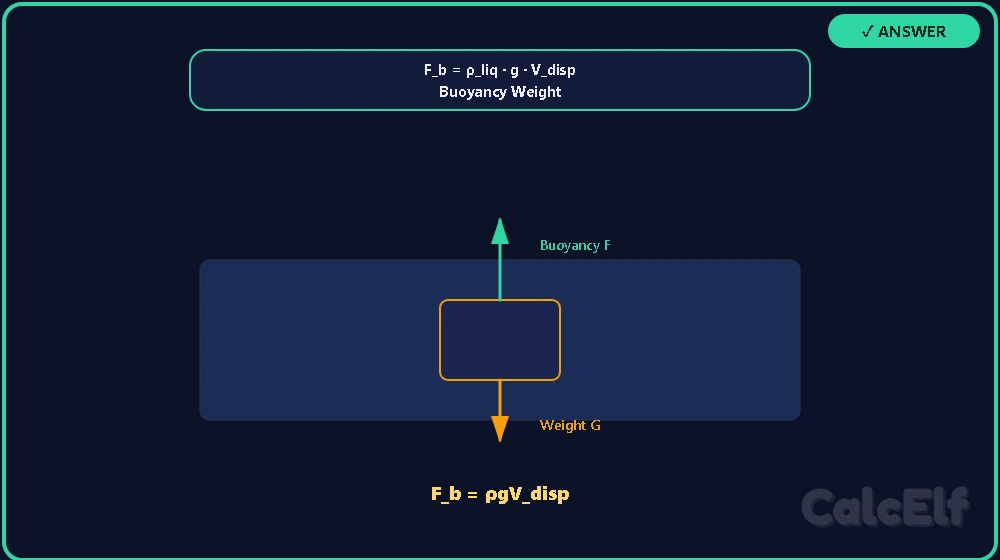
Stage 3 — Conclusion: ρ_obj = 0.5 ρ_liq = 1.
A floating body is in balance, so the upthrust equals its weight: ρ_water × V_submerged = ρ_block × V_total.