 CalcElf
Lap race: 500 m track, 140 and 90 m/min
On a 500 m circular track, two runners start together from the same point and run in the same direction at 140 m/min and 90 m/min. After how many minutes does the faster runner first catch up with the slower one?
Step-by-step
- 140 − 90 = 50Moving the same way, the relative speed is the difference of the speeds
- 500 ÷ 50 = 10Time to lap on a circular track = distance ÷ relative speed
Why it works
To catch up on a lap, the faster runner must gain exactly one full lap; the gain each minute is the difference of the speeds, so the time is the lap length divided by that difference.
Common mistakes
- Adding the speeds as if they ran toward each other.
- Dividing the 500 m lap by the faster runner's own speed.
Related
catch-up-lap-400m-150-100 meeting-problem catch-up-lap-700m-190-140
Stage diagrams
Set up 1 — Lap race: 500 m track, 140 and 90 m/min
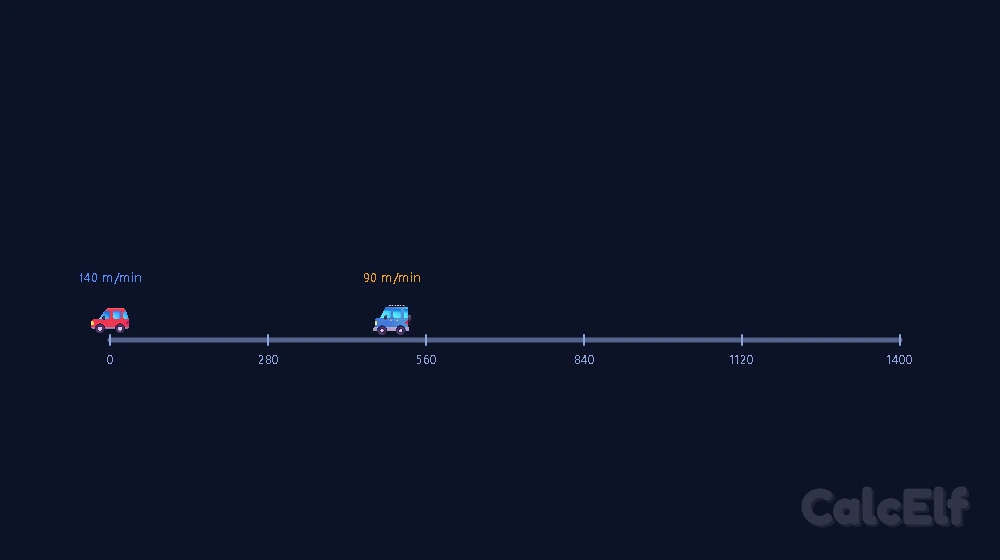
Stage 1 — Set up: Read the problem and mark the given values and the target. Lap race: 500 m track, 140 and 90 m/min
To catch up on a lap, the faster runner must gain exactly one full lap; the gain each minute is the difference of the speeds, so the time is the lap length divided by that difference.
Work the relation 2 — Lap race: 500 m track, 140 and 90 m/min
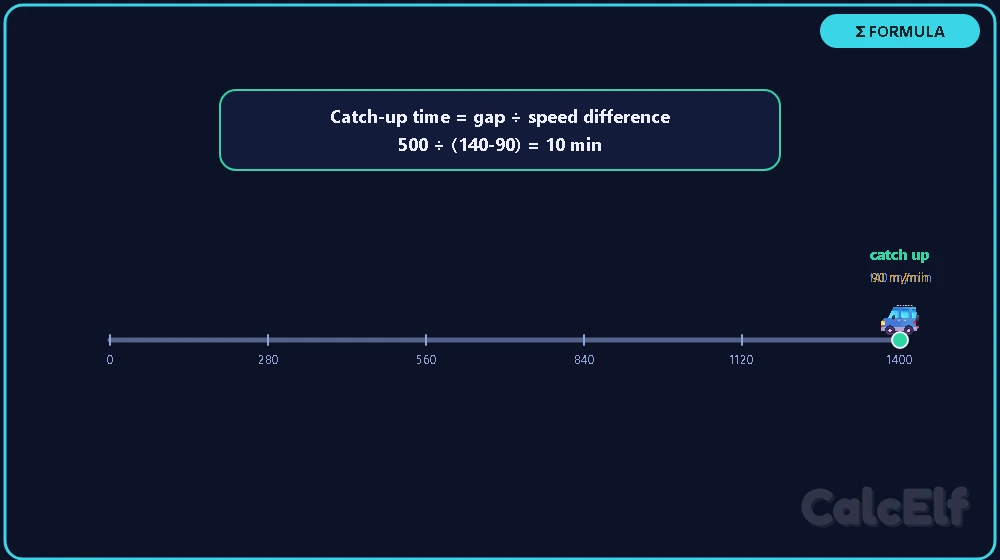
Stage 2 — Work the relation: 140 − 90 = 50
To catch up on a lap, the faster runner must gain exactly one full lap; the gain each minute is the difference of the speeds, so the time is the lap length divided by that difference.
Conclusion 3 — Lap race: 500 m track, 140 and 90 m/min
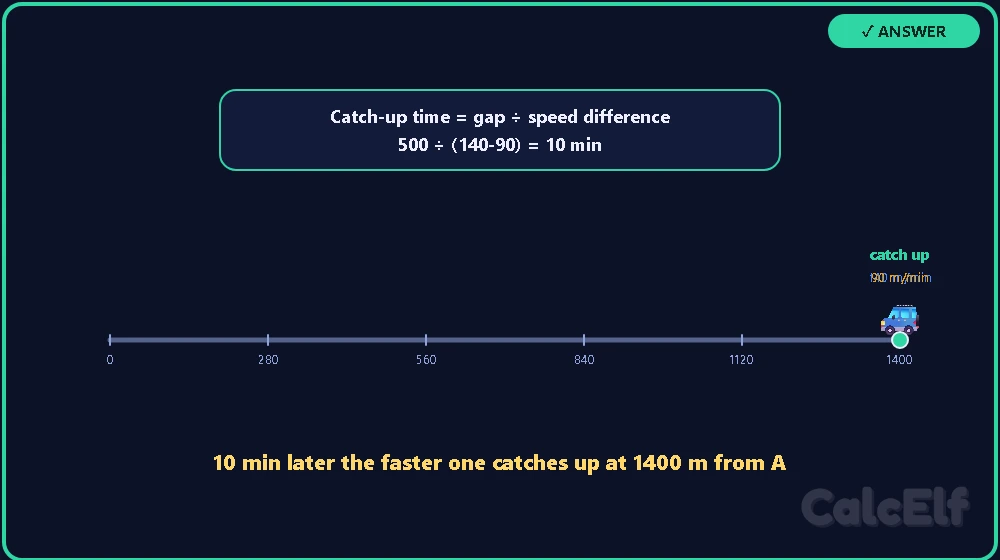
Stage 3 — Conclusion: 500 ÷ 50 = 10.
To catch up on a lap, the faster runner must gain exactly one full lap; the gain each minute is the difference of the speeds, so the time is the lap length divided by that difference.