 CalcElf
Floating foam block: submerged fraction
A foam block of density 0.4 g/cm³ floats in water of density 1.0 g/cm³. What fraction of its total volume is submerged?
Step-by-step
- V_sub/V = ρ_object/ρ_fluid = 0.4/1 = 40%When floating, buoyancy equals weight: ρ_fluid·g·V_sub = ρ_object·g·V
- ρ_object = 0.4 , ρ_fluid = 1Comparing the object's density with the liquid's tells you whether it floats
Why it works
The upthrust on a floating body equals its weight, so ρ_water × V_submerged = ρ_block × V_total. Its submerged fraction is thus the block's density divided by the water's density.
Common mistakes
- Setting up the ratio as 1.0 ÷ 0.4 and getting 2.5.
- Believing a light block must be completely under the water.
Related
buoyancy-float buoyancy-wood-block-float-ratio buoyancy-plastic-block-0-5-float-ratio
Stage diagrams
Set up 1 — Floating foam block: submerged fraction
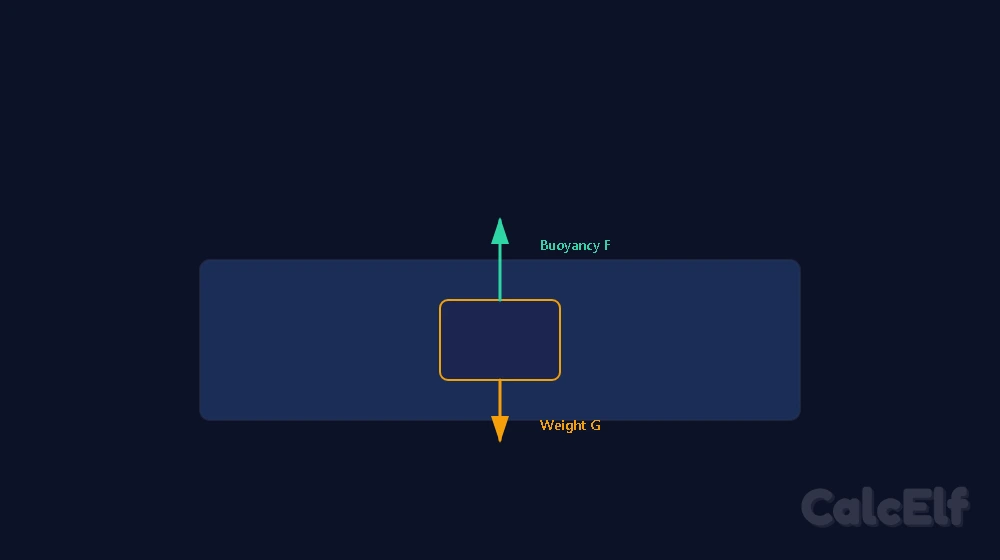
Stage 1 — Set up: Read the problem and mark the given values and the target. Floating foam block: submerged fraction
The upthrust on a floating body equals its weight, so ρ_water × V_submerged = ρ_block × V_total. Its submerged fraction is thus the block's density divided by the water's density.
Work the relation 2 — Floating foam block: submerged fraction
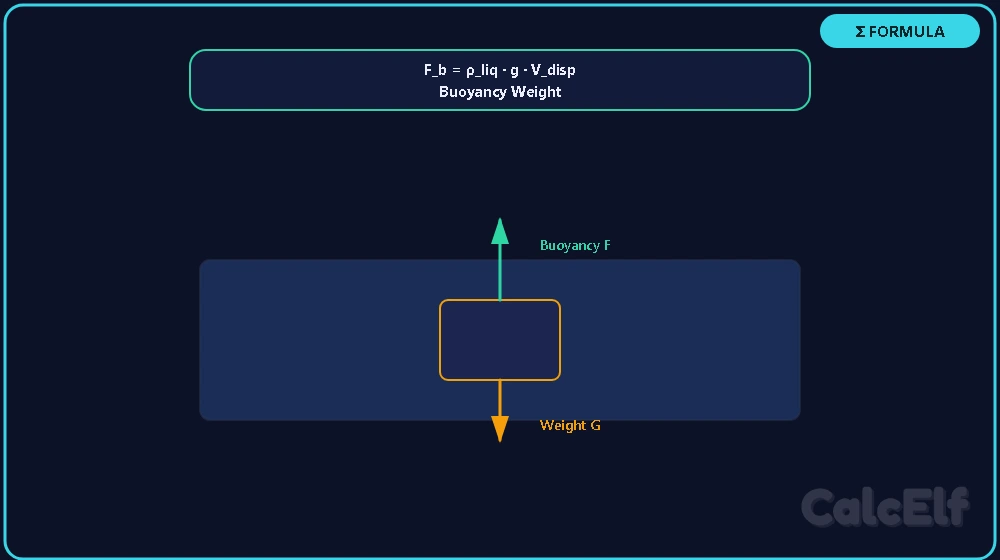
Stage 2 — Work the relation: V_sub/V = ρ_obj/ρ_liq = 0.4/1 = 40%
The upthrust on a floating body equals its weight, so ρ_water × V_submerged = ρ_block × V_total. Its submerged fraction is thus the block's density divided by the water's density.
Conclusion 3 — Floating foam block: submerged fraction
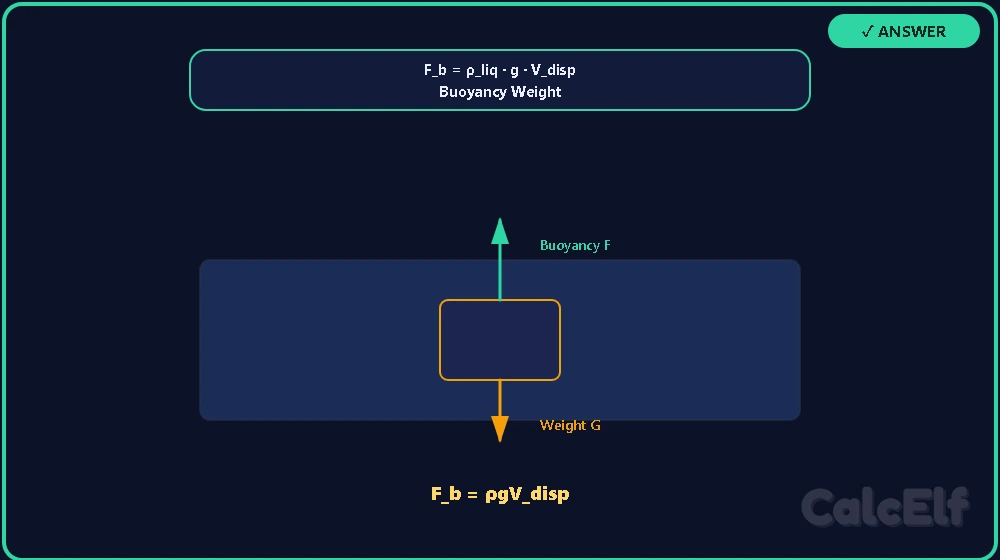
Stage 3 — Conclusion: ρ_obj = 0.4 ρ_liq = 1.
The upthrust on a floating body equals its weight, so ρ_water × V_submerged = ρ_block × V_total. Its submerged fraction is thus the block's density divided by the water's density.